Production
1984 – 1994
Engines
Petrol
2.0 L Fiat 834B I4
2.0 L Fiat 834C.146 turbo I4
2.8 L PRV V6
3.0 L Alfa Romeo V6
2.9 L Tipo F105L V8
Diesel
2445 cc Sofim 8144.91 turbodiesel I4
2499 cc Sofim 8144.97 turbodiesel I4


Production
1984 – 1994
Engines
Petrol
2.0 L Fiat 834B I4
2.0 L Fiat 834C.146 turbo I4
2.8 L PRV V6
3.0 L Alfa Romeo V6
2.9 L Tipo F105L V8
Diesel
2445 cc Sofim 8144.91 turbodiesel I4
2499 cc Sofim 8144.97 turbodiesel I4
Designers
Giorgetto Giugiaro at Italdesign (saloon)
Pininfarina (station wagon)
Body styles
4-door saloon
5-door station wagon
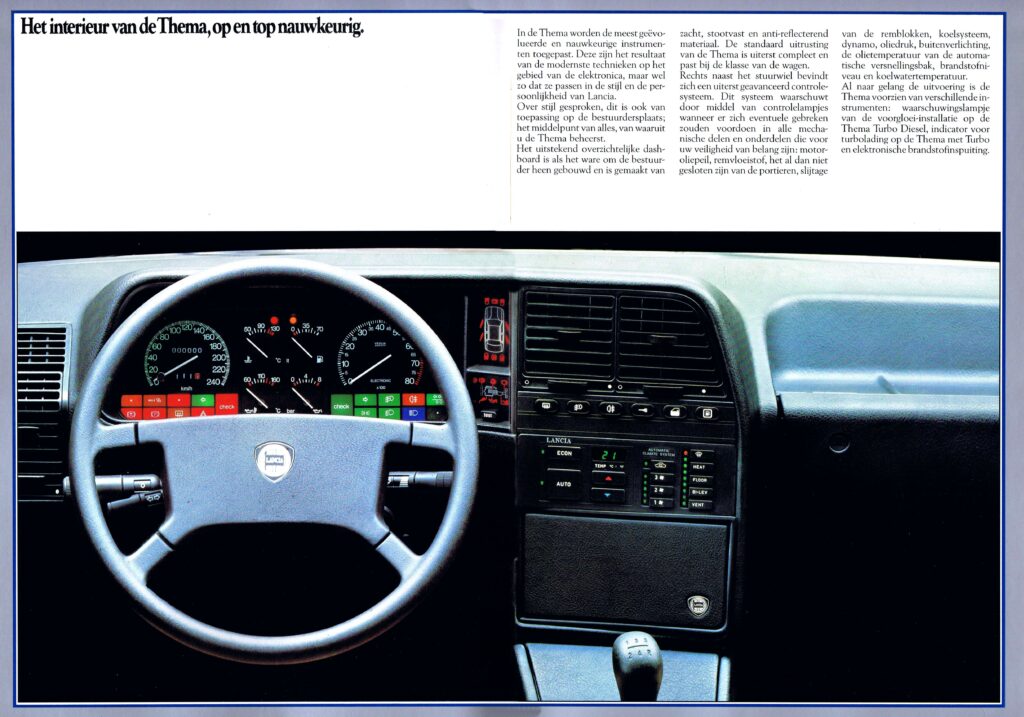
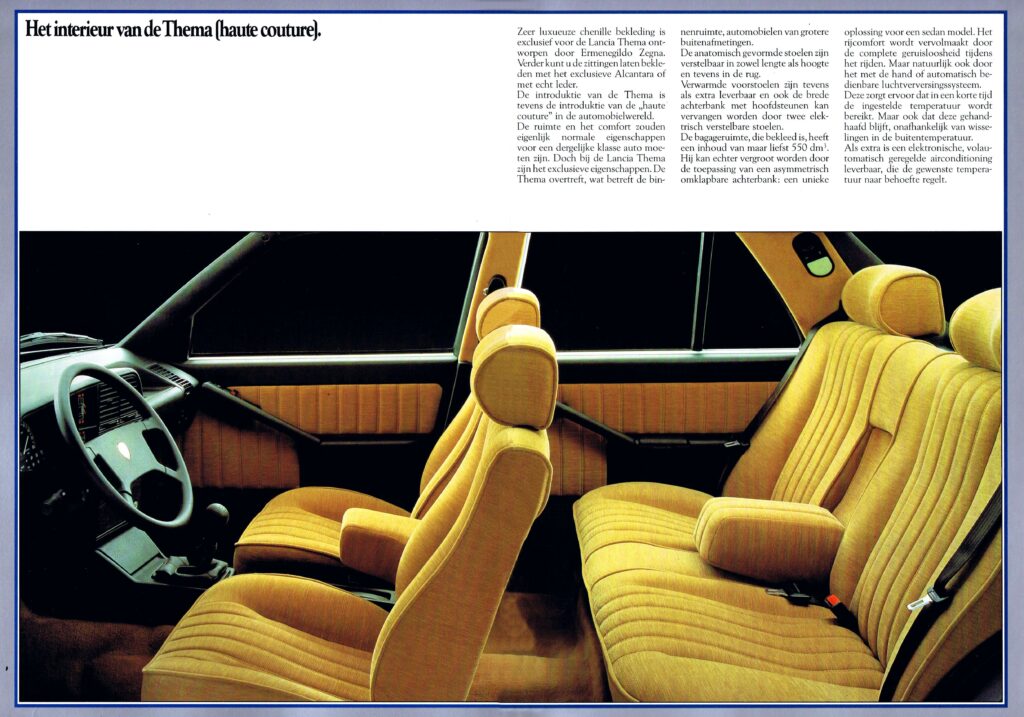


The Thema was first shown in Turin Motor Show in 1984. In February 2011, it was reported that the second generation of the Chrysler 300C, due for launch later that year, would be marketed as Lancia Thema in all European markets, except the UK and Ireland, which would retain the 300C nameplate.
The Thema was Lancia’s luxury car based on the all-new Type Four platform, co-designed with the Fiat Croma, Saab 9000 and Alfa Romeo 164. The Thema was available as a saloon and as a station wagon designed and produced by Pininfarina.
The Lancia Thema was announced in May 1984,[5] then introduced to the motoring press with an event held in October 1984 in Vienna, and to the general public at the Turin Motor Show in November of the same year.
The first series Thema was built between 1984 and 1988, with four different models initially available. Two came with a twin cam 8-valve, fuel injected 1,995 cc 4-cylinder petrol engine, in naturally aspirated guise on the Thema i.e. or turbocharged and intercooled on the Thema i.e. turbo. Engine output was 120 PS and 165 PS respectively. The most expensive model was the Thema 6V, powered by a 150 PS, 2,849 cc V6, tuned for smoothness. On most European markets a 2,445 cc, 100 PS four-cylinder turbocharged and intercooled four-cylinder diesel engine was also available, on the Thema turbo ds. 1986 saw the introduction of the Pininfarina-designed Thema Station Wagon, available with the two turbocharged engines only,[7] and of the Ferrari V8-engined Thema 8·32.
The second series Thema was presented in the Paris Motor Show in September 1988.[8] New 16-valve 2.0-litre engines replaced the previous 8-valve units, increasing the power output to 147 PS (108 kW) on the naturally aspirated Thema i.e. 16v and to 185 PS (136 kW) on the Thema turbo 16v. The 8-valve 2-litre, now producing 117 PS (86 kW), remained on sale on the Thema i.e. base model. The 147 PS (108 kW) six-cylinder on the Thema V6 was only mildly revised. The diesel engine on the Thema turbo ds increased marginally in capacity, to 2,499 cc, and more significantly in output, to 118 PS (87 kW).[8]
A number of small visual updates were made to freshen the Thema’s look. Upfront there was a more prominent grille with vertical instead of horizontal bars, and the turn indicators had been moved beneath the main headlamp units, under horizontal dark-tinted lenses. At the rear all model badging was removed, and the turn signals and backup lamp lenses were now tinted red. Finally the side rubbing strips, side skirts, wheel covers and 8-spoke alloy wheels were redesigned. The station wagon and the 8·32 received similar updates. With five engines available of the saloon, three on the SW (the two 16-valve petrols and the turbo diesel) and the 8·32, the Thema range consisted of nine different models. The different models received almost no visual distinctions, aside from the 8·32. Other models looked largely identical aside from badging, wheel dimensions, and wheel design (along with body-coloured mirror housings on top versions).[9] Additionally the 4- and 6-cylinder petrol engines were also produced in catalytic converter-equipped versions, with slightly reduced output, for sale on markets where such equipment was mandatory.
The series two was then replaced by the facelifted third and last series, introduced in the Paris Motor Show in September 1992 and produced from 1992-1994. Four trim levels—base, LE, LS and LX—were introduced across the range; the 2.9-litre V6 engine was replaced by a more powerful 175 PS 3.0-litre unit, sourced from Alfa Romeo.
Production of the Thema ceased in 1994, when Lancia also withdrew entirely from RHD markets (including the United Kingdom) in response to falling sales. The Thema was replaced by the Lancia Kappa. A total of over 336,000 Thema saloons were produced.