Production
1986 – 1992
Engines
Petrol
2.9 L Ferrari V8



Production
1986 – 1992
Engines
Petrol
2.9 L Ferrari V8
Designers
Giorgetto Giugiaro at Italdesign (saloon)
Pininfarina (station wagon)
Body style
4-door saloon
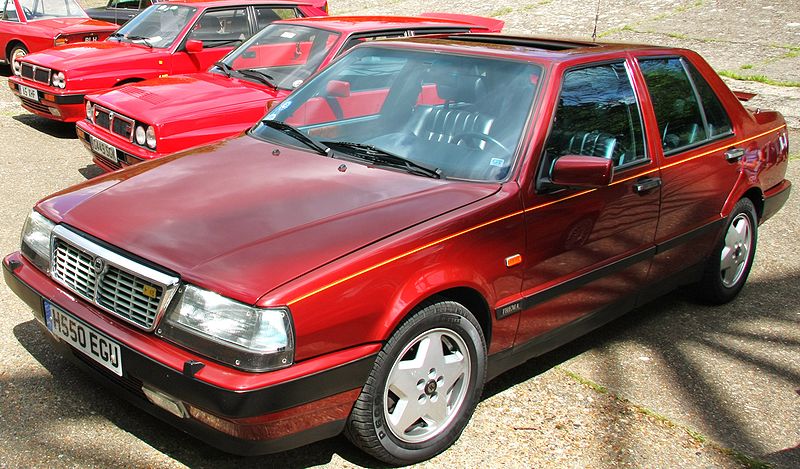
First shown at the Turin Auto Show in 1986, the Lancia Thema 8·32 (“8” standing for the number of cylinders and “32” for the number of valves) was assembled at Lancia’s S. Paolo plant in Turin.
Catalysed versions produce 205 PS (151 kW), which gave 0–100 km/h in 7.2 seconds and a top speed of 235 km/h (146 mph). The transmission was a 5-speed manual gearbox; there was no automatic option. The braking system used larger 294 mm vented front discs and the standard 251 mm rear ones from the other Themas. and in the Ferrari Mondial and some of the componentry was assembled by Ducati from castings made at Maranello. The engine differed from other Ferrari V8s of the time in that it was equipped with a V8 engine cross-plane type crankshaft rather than the usual flat-plane crankshaft, smaller valves and different firing order: all this was to make the engine characteristics more suitable for a four-door luxury saloon. In non catalysed form the engine produced 215 PS (158 kW) at 6,750 rpm, and the car was capable of 0–100 km/h in 6.8 seconds and a top speed of 240 km/h (149 mph).
All 8·32s featured Bosch KE3 Jetronic fuel injection, Anti-lock braking system ZF Friedrichshafen’s brand new Servotronic electronically controlled rack-and-pinion power steering (which varied steering wheel effort according to vehicle speed), and a retractable rear spoiler. The latter, designed to increase high speed stability, was controlled by the driver via a rotary switch on the right stalk. In closed position, it would fit flush with the boot lid. The tyres were specially developed 205/55 VR15 Goodyears on five-spoke 6J×15 Alloy wheels.
The car offered a handmade wood-and-Alcantara (or optional Poltrona Frau leather) interior, and was complete with similar luxury equipment as LX versions of the Thema. Stitched leather covered the entire dashboard, the steering wheel (including centre), gear and handbrake levers and booths, centre console, door panels and sun visors, while the headlining was Alcantara. A bespoke dashboard fascia housed two main instruments, six small auxiliary gauges, and triple round air conditioning vents. Like the door cappings and the lids concealing the radio and ashtray, it was veneered in matte varnish burr wood. The instrumentation had black dials with yellow hands and markings; it included water thermometer, oil thermometer and pressure gauge, and check panels for the lights and the drivetrain. The seats (and matching door panel inserts) were trimmed in beige or date brown Alcantara as standard, with black or brown leather was an optional extra. Brown interiors got colour-matching switchgear, carpets and trim. Irrespective of interior selection, Thema 8·32 buyers could choose from five paint colours, all metallics: Blizzard Blue, Winner Red, Quartz Grey, Reflex Green and Black. A double hand-painted pinstripe (the upper matched to body colour, the lower yellow) ran along the sides and the rear of the car. Besides the paint scheme, retractable spoiler and wheels, the only exterior details setting the 8·32 apart from other Themas were yellow “8·32” badges, a silver eggcrate-type grille, and twin exhaust outlets. Some notable options were automatic climate control, electrically actuated sunroof, provision for a car phone in the front armrest, and rear individual power seats.